

Table of Contents
This is your sign to start pricing your art more confidently.
If you’ve ever felt guilty charging for your artwork, you’re not alone. But you’re running a business, and you need to turn a profit to keep creating. Whether you struggle with undervaluing or overpricing — and the fear of losing sales — we’re here to help you find a formula for pricing art that works for you.
Pricing Methods Quick Start:
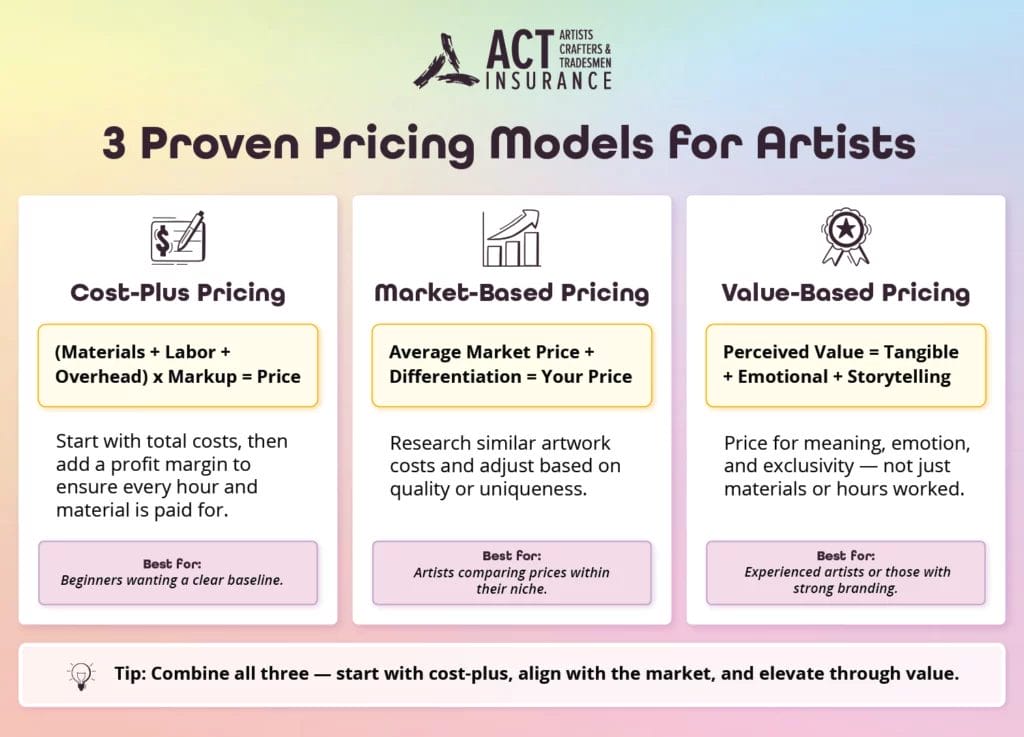
- Cost-Plus: Price = (Materials + Labor + Overhead) × Markup
- Market-Based: Retail Price = Average Market Price + Differentiation Adjustment
- Value-Based: Perceived Value = Tangible Value + Emotional Value + Storytelling Power
Combine all three formulas to set competitive prices that cover your costs and highlight the emotional value of your artistry!
Understanding the True Cost Behind Your Artwork
| Direct | Indirect Costs (Overhead) | Labor (Time) |
|---|---|---|
|
Materials |
Studio rent and utilities costs
|
Ideation |
|
Art tools
|
Online marketplace seller fees
|
Design and creation
|
|
Framing |
Event application fees
|
Photography |
|
Packaging |
Shipping fees
|
Packing and shipping
|
|
|
Travel costs
|
Listing items for sale
|
|
|
|
Selling at events ( + travel time)
|
Creators often forget the costs of hidden labor when calculating pricing. Blank canvases or tubes of oil paint have obvious monetary values, but don’t forget the time and effort you put into making and selling art.
This also includes the time you spend gathering inspiration and the hours you’ve spent honing your technique. Price your work to reflect the culmination of time you’ve invested in your artistry. Each piece is made possible by all your previous experience creating!
Did you know? If you’re selling at markets, many venues require proof of liability coverage before approving you as a vendor. Get vendor insurance in minutes (then build it into your price).
TL;DR: Your pricing should factor in the costs of tangible items used, the cost to make artwork and selling possible, and the value of your labor as an artist.
Consider the prevailing market rather than your emotions. Look at artists with similar experience and skill in your medium and market. This helps establish a realistic pricing range. From there, factor in your materials, time, and the uniqueness of your voice. You’re not just selling hours and paint — you’re selling the years it took to master your craft.”
— Becky Sciullo, Founder of Art Is An Advantage

3 Art Pricing Formulas That Work
Learning how to price art for profit doesn’t have to be overcomplicated. Here are three simple, adaptable formulas to try. The best part is that you can combine them to reflect both the value of your work and what customers are willing to pay.
Cost-Plus Pricing: The Baseline Approach
Cost-plus pricing is the simplest (and most common) starting point for artists. Begin with your total costs, then add a profit margin that reflects your time, skill, and desired earnings. Think of it as a baseline pricing formula.
Formula:
(Materials + Labor + Overhead) x Markup = Retail Price
- Materials: The cost of the raw items used (paint, pastels, clay, etc.)
- Labor: What you pay yourself per hour x hours spent
- Overhead: Business expenses (studio rent, tools, etc.)
- Markup: Multiply for profit (typically 2-3x for retail)
Here’s an example of the formula in action:
- Materials: $15
- Labor: 3 hours x $20/hour = $60
- Overhead: $10
- Subtotal: $85
- Retail price: $85 x 2.5 = $212.50
The retail price is the final price tag you put on your product, ensuring you’re paid fairly for every minute and dollar put into the piece.
Pro Tip:
Overhead costs may add up quickly, but a single lawsuit could cost you hundreds of thousands of dollars. Learn more about handmade insurance from ACT, starting from $24.25/month — way more affordable than handling a claim on your own.
Market-Based Pricing: The Competitive Approach
Market-based pricing involves researching what other artists charge for similar items and positioning your prices around that range. This competitive pricing formula helps you confidently ease into the market and strategize how to stand out.
Formula:
Average Market Price + Differentiation Adjustment = Retail Price
- Average market price: The going rate for similar handmade items
- Differentiation adjustment: How your work compares in quality, materials, or uniqueness
If your artwork involves more intricate techniques or exclusive mediums, you might add 10–30% for the differentiation adjustment.
For instance, imagine most original paintings of similar size and subject sell for $80–$100 at local markets, and your pieces are made with archival-quality pigments and a distinctive layered texture style no one else has:
$90 (average market price) + 20% (for uniqueness) = $108 (your retail price)
Regardless of your niche, market-based pricing is a smart way to see what customers are willing to pay and adjust for what makes your products special.
And remember: avoid undercutting just to compete. It’s difficult to build a brand as an artist if your potential customers doubt your work’s quality because it’s priced too low. Let your creativity outshine the slew of mass-produced goods on the market with strategic pricing tailored for your niche.
Value-Based Pricing: The Emotional Approach
Just as the name implies, value-based pricing is setting your prices based on perceived value. It may be the most challenging pricing model to embrace because it recognizes that people buy art because of how it makes them feel.
How can you put a price on emotion?
Conceptual Formula:
Perceived Value = Tangible Value + Emotional Value + Storytelling Power
This formula requires imaginative calculation. Think about what your piece represents to the buyer, based on originality and emotional resonance, and set a price communicating that value.
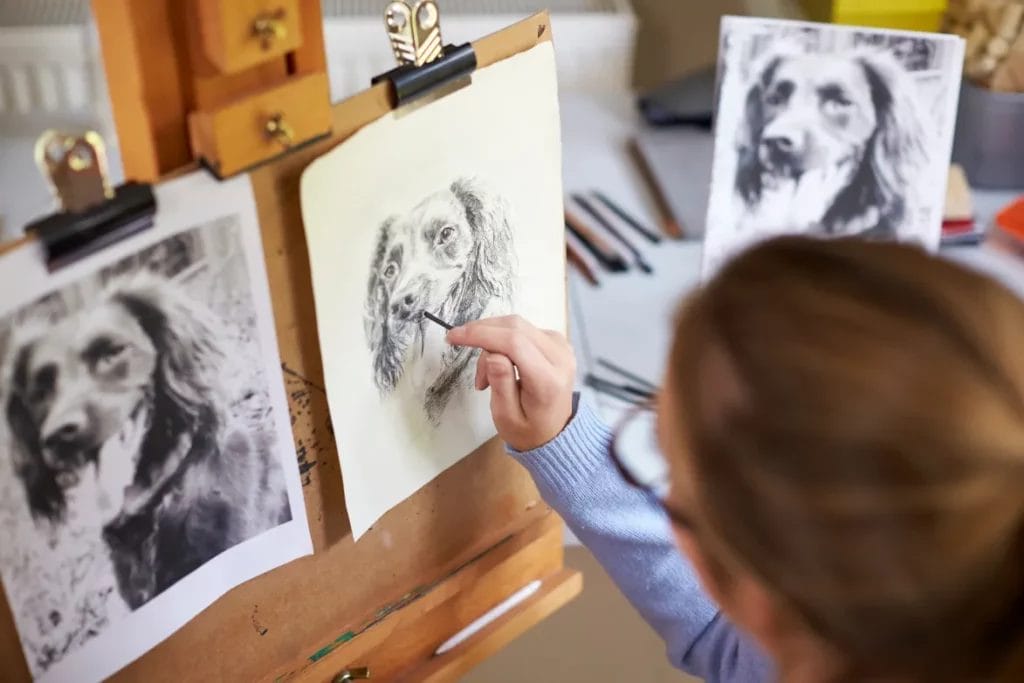
For example, you create custom pet portraits, and your cost-plus model calls for a retail price of $175 (based on materials and hours of work). But your portraits capture pets in a deeply personal way — say you specialize in memorial art — the perceived value could justify a price of $300 or more.
The difference between $175 and $300 recognizes the emotional worth of your art. It’s one of a kind and represents the relationship between a person and their pet. If you offer work that no one else does, your pricing should reflect what your product means to potential buyers.
You can raise perceived value through:
- Storytelling: Share the inspiration or process behind your work
- Presentation: Brand your work professionally and cohesively
- Scarcity: Sell original or limited runs of your artwork
Combining All 3 Formulas
You don’t have to pick just one of these pricing strategies. In fact, we recommend combining all three formulas to create a solid pricing game plan that accounts for materials, labor, competitors, and emotional value.
Here’s how to do it:
- Start with cost-plus (baseline) pricing to ensure you’re covering expenses
- Check market-based pricing to stay realistic and competitive
- Layer in value-based adjustments to charge confidently for the meaning your work creates
Like your latest masterpiece, your ideal pricing will be unique to your artistry. Also, keep in mind that even though setting prices is part of the “business” side of selling art, it’s still a creative decision, and ultimately, totally up to you.

The Psychology of Pricing Art
Buying is an experience, and pricing can act as a psychological signal, both good and bad. Use this to your advantage by thinking of pricing as an extension of your art, communicating the worth of your work.
Here are a few things to remember when finalizing your pricing:
- Avoid fostering doubt by pricing too low. It sends the message that you don’t believe your work is worth more. Set fair, confident pricing that says, “This piece is special and made with care.”
- Use odd vs. round pricing strategically. Odd pricing ($49) can feel more “optimized” or “specific,” and round pricing (a flat $200) leans more “high-end.” Try using odd pricing for your mid-range items and round pricing for fine art pieces to reinforce quality.
- Use storytelling to earn each price. For example, highlight how a specific glaze takes several days to cure, resulting in the specialized, ocean-inspired wave texture on the final piece.
- Battle AI art pricing pressure by leaning into the humanity of your art. Imperfections, mindful processes, and personal connection make your creations worth much, much more than what a computer can generate. Share a time-lapse of your work to emphasize the extra time and care it takes to offer your products.
As a pressed flower frame artist and personalized gift creator, pricing my work was one of the hardest parts of my business. I used to price based on what I thought people would pay, until I learned to reverse-engineer my pricing from what I need to earn per hour.
That shift removed the guilt completely. Now, if someone’s budget doesn’t align, I know it’s not about being overpriced, just not the right fit. When that happens, I simply say, ‘Thank you so much for reaching out! If your budget changes, I’d love to work together,’ and move forward with confidence in the value of my work.”
— Abby Rees, Founder of Keepsake Journey
Protect Your Art Profits With ACT Insurance
With a smart pricing strategy and boundless creativity, your art business is bound to grow! But have you ever considered what would happen if a customer claimed your product injured them or if your valuable tools and supplies were stolen?
Protect your business against costly claims with liability insurance. ACT Insurance offers two policies, ACT Pro and ACT Go, to safeguard your creativity against common claims creators face. Plus, get options to cover your art supplies and inventory in case of theft or damage.
ACT keeps up with your creativity, with instant online coverage for all kinds of artistry:
FAQs About How to Price Your Art
What’s the Best Formula to Price Handmade Products?
The easiest way to price handmade products is cost-plus pricing, which is:
(Materials + Labor + Overhead) x Markup = Retail Price
To enhance your pricing formula, evaluate your retail price against the market and your work’s perceived value. Increase your price for factors like differentiation (what makes it unique from what’s on the market), originality, emotional value, or scarcity.
How Do I Raise Prices Without Losing Customers?
Raise prices effectively by communicating clearly to your customers why you’re making the change. It’s still part of your story, so tell it authentically! Your customer base will appreciate the transparency.
Use warm, clear messaging, like “Over the past year, I’ve grown as an artist, investing more in materials and time. To keep creating work I’m proud of and sustain my practice, I’ll be updating my prices starting [date]. Thank you for supporting handmade art.”
Do I Need Business Insurance Once I Start Selling My Artwork?
Yes, you need business insurance the moment you start selling your creative work! If your products accidentally injure a customer or damage their property, you can be held legally responsible for those damages.
Vendor insurance through the ACT Pro policy protects your art business from claims like slip-and-falls at your booth, product-related incidents, and more — so you can focus on sharing your creativity confidently.
How Can You Price Your Art for Beginners?
How Much Should I Charge for a 24’’ x 36’’ Painting?
How Do You Know Your Art Is Good Enough to Sell?
What Type of Art Sells Fast?
Art that connects emotionally or complements modern interiors (think abstracts, nature-inspired, graphic text, or minimalist pieces) tends to sell quickly. If faster sales are your goal, aim to create work that’s both trend-aware and authentic to your brand.
